While New York City’s affordability crisis is no secret – and remains a central and driving focus of the Mamdani Administration – its scale is still larger than many realize. ANHD’s 2026 AMI Cheat Sheet makes clear just how large the scale is, and how central the need for regulated, deeply affordable housing is in addressing it. This year, for the first time since ANHD started putting out its annual AMI Cheat Sheet, we find that the majority of NYC’s renter households are Very Low and Extremely Low Income – with 51.3% of renter households making below 50% AMI. For a household of 3 that means a maximum yearly income of $76,350 and rent no higher than $1,909 for an affordable two-bedroom apartment. These same renter households make up 79.7% of all rent-burdened households in the city, meaning they pay more than a third of their monthly income towards rent.
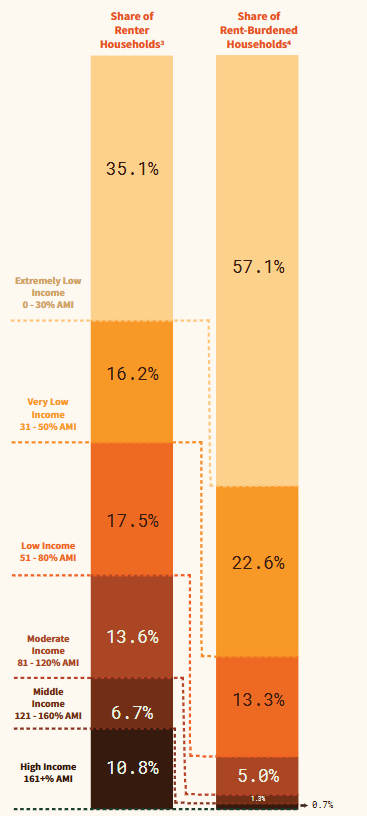
Yet even within this majority of renter households, over half of them are Extremely Low Income, earning less than 30% AMI. For a household of 3 that means a maximum income of $45,810 and a rent no higher than $1,145 for an affordable two-bedroom apartment – rents that are extremely hard to find on the unregulated market. It’s no wonder that these households alone make up more than half – 57.1% – of all rent-burdened households in the city.
As the 2026 AMI Cheat makes clear, it’s no longer right to think of affordable housing as housing that serves just a subset of New York City’s renter population. A majority of NYC renters need not just affordable housing, but deeply affordable housing, at rents that the unregulated market generally does not provide. As last year’s Cheat Sheet analysis showed, this is also the housing that we’re not producing enough of today.
This makes it all the more pressing to plan for the housing we need, not just the housing that’s easiest to build. Unfortunately that’s not the direction the Mamdani administration chose to take with the recent release of the Fair Housing Growth Strategy. By doubling-down on a supply-side approach that flattens the difference in impact between an affordable and unregulated housing unit, the administration has put forward a plan that fails to either identify or grapple with the type of housing our city truly needs.
The Fair Housing Growth Strategy was mandated by City Council legislation (Local Law 167 of 2023) to lay out a transparent and equity-focused assessment of our city’s housing needs and to establish targets for how we can best meet them. Among other considerations, the legislation specifically mandated that the plan include a citywide assessment of the number of affordable housing units, deeply affordable housing units, and housing serving formerly homeless households that are needed to provide housing opportunity for households of all socio-economic levels. In releasing their final plan, the administration chose to ignore these requirements and instead focused solely on the total number of housing units needed, without considering which types of households they would serve and how many units would be out of reach for those who need affordable housing the most.
By ignoring this affordable housing needs assessment and instead focusing on a topline number, the administration was able to put out targets that are not reflective of our city’s true need. The chart below shows just how misaligned these targets are.
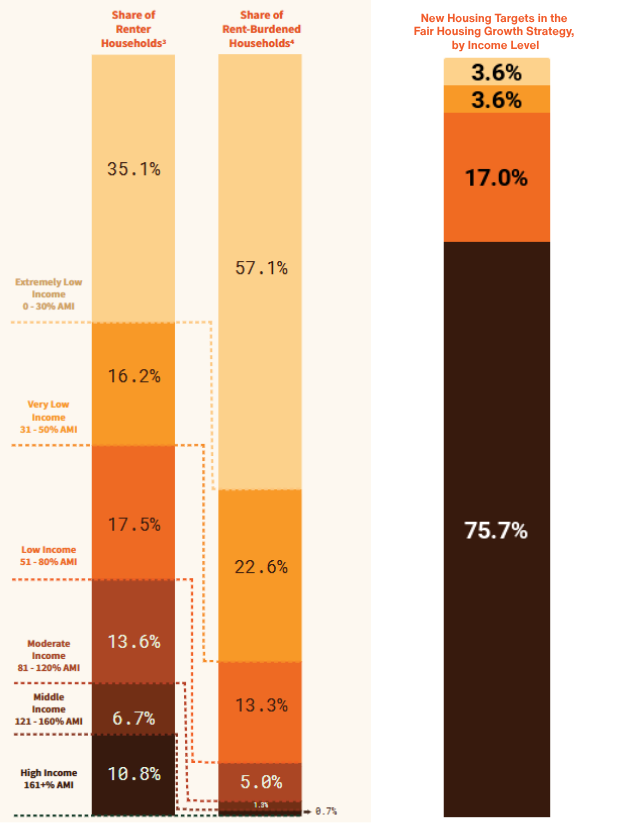
The plan calls for just 25% of the total citywide new housing targets to be affordable – but these numbers get even worse the further down in income you go, where the need for deeply affordable housing is especially urgent. Here’s how the affordability targets in the plan break down:
- Of the total citywide housing targets:
- 24.3% are designated as affordable housing
- Leaving 75.7% designated as unregulated, market-rate
- Of the affordable housing targets:
- 30% are designated as deeply affordable below 60% AMI
- Leaving 70% designated as affordable above 60% AMI
- Of the deeply affordable housing targets:
- 50% are designated as formerly homeless housing – generally pegged 30% AMI and below
- Leaving 50% designated as affordable between 31-60% AMI
| AMI Levels | Fair Housing
Growth Strategy Targets |
Percent of Total Targets
(out of 350,000 units) |
| Unregulated/Market-Rate
(161+% AMI) |
265,000 | 75.7% |
| Affordable
(61 – 160% AMI) |
59,500 | 17.0% |
| Deeply Affordable
(31 – 60% AMI) |
12,750 | 3.6% |
| Formerly Homeless
(0 – 30% AMI) |
12,750 | 3.6% |
Taken together, this means just 3.6% of the targeted units are aimed at 30% AMI or below, with an additional 3.6% aimed between 30 – 60% AMI. This despite the fact that households at these income levels combined make up over 50% of all renters in NYC, and over 80% of all rent-burdened households.
This is extremely disappointing for an administration that has made addressing the affordability crisis such a central focus, and that has thus far done impressive and impactful work to advance the most aggressive affordable housing approach in NYC history. The intention of the Fair Housing Growth Strategy is to create an honest assessment of the housing need in our city, by taking into account the disparate needs across different demographics, including by income and rent-burden, to determine the type of housing that would best serve them. By choosing to ignore this approach, and both the intention and requirements of the legislation, the administration is sending a message that they are following the same flat supply-side and trickle down approach to the affordable housing crisis that has not worked across previous administrations. ANHD’s 2026 AMI Cheat Sheet makes clear where the need for affordable housing truly lies, and how much further we have to go. We urge the administration to approach its work, including on the Fair Housing Growth Strategy, with a clear understanding and recognition of this need, to continue their success now and for future generations.